
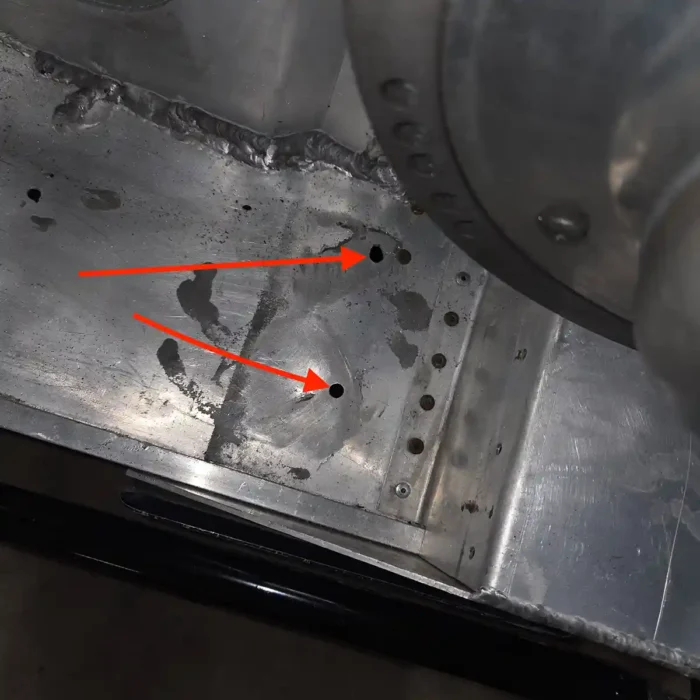
Ever look at those holes under the clutches of a 78 RXL and wondr “What the heck or those for?”
Well, we’ll get to that. First lets tackle some myths.
There probably isn’t another vintage Polaris snowmobile that has generated more stories, rumors, and outright myths than the 1978 RXL.
That’s understandable. They were purpose-built race sleds, they were produced in relatively small numbers, and for many years there wasn’t much documentation available. As a result, stories were passed from racer to racer until they became accepted as fact.
The funny thing is, many of those “facts” simply aren’t true.
Let’s take a look at four of the biggest misconceptions surrounding the legendary RXL, then I’m going to show you the rarest part for an RXL today.
Myth #1: The RXL Was Never a Production Snowmobile
False.
Yes, the RXL was designed specifically for ice oval racing. It wasn’t intended to be a trail sled, and it certainly wasn’t marketed as one. But it absolutely was a production snowmobile.
The RXL was assembled on the Polaris production line, carried production serial numbers, and appeared in the 1978 Polaris sales catalog alongside every other production model. If your Polaris dealer wanted to order one for you, they could.
Okay, so the “production line” was a bunch of saw-horses in the Race Department and Jim Bernat’s garage, but it was still a production line.
It may have been built for racing, but it was every bit as much a production Polaris as any other sled in the 1978 lineup.
Myth #2: Polaris Only Built a Handful of Them
Another myth that refuses to disappear. You’ll often hear someone say Polaris built “about a dozen” or “maybe twenty” RXLs.
The surviving production records tell a different story. Polaris built approximately 106 production RXLs for the 1978 model year. Every one left the factory with the remarkable 340cc liquid-cooled Fuji monoblock twin.
If you include the approximately forty-plus hand-built factory race machines constructed during the 1977 and 1978 seasons, and the chassis built with no engine, total production comes in around 150 machines.
That’s certainly rare. But it’s more than “a handful.”
Myth #3: About 100 Rigid Front-End RXLs Were Built
This story actually has a fascinating origin.
The belief is that while the production RXL introduced Polaris’ revolutionary Independent Front Suspension (IFS), roughly one hundred conventional leaf-spring versions were supposedly built as well.
They weren’t. Only three rigid-front “leafer” RXLs were built for the 1977 factory racing program, and all three were replaced by the end of that season with IFS machines.
So where did the “100” number come from?
Ironically… from Polaris itself.
At the 1979 Eagle River World Championship, Lee Hausken entered one of the original factory-built rigid-front RXLs in the Mod Stock class. Another competitor protested, arguing that Lee was racing a hand-built factory prototype that never met the minimum production requirements for a stock-class machine.
Lee walked over to the Polaris race trailer and explained the situation. The Polaris representatives understood exactly what was at stake.
When race officials asked how many had been produced, the answer they received was wonderfully vague: “Oh… we built about a hundred of them.”
That was enough. The protest disappeared, Lee raced, Lee won the class handily (after all his leafer was around 30 to 50lbs lighter than a stock sled) and somewhere along the way that convenient little white lie became accepted as historical fact.
Nearly fifty years later, people are still repeating it.
Myth #4: You Could Buy an RXL With a 250 or 440 Engine
Not exactly. Every consumer RXL sold by Polaris came equipped with the 340cc liquid-cooled monoblock Fuji twin.
There were no factory-built 250cc or 440cc consumer RXLs as far as we know.
However, Polaris did sell a number of bare RXL chassis without engines. That allowed serious racers to install one of the 250cc Super Mod engines, which fit fairly easily. Not many people took this option, but a few did, and that makes a 250 much rarer than the 340s.
Installing a 440 was another story entirely. The larger engine required extensive chassis modifications, and it’s still unclear whether Polaris ever completed such a conversion for a customer. If it happened, it certainly wasn’t common.
Now For The Rarest RXL Part You’ve Probably Never Seen
Now for my favorite piece of RXL trivia.
Take a look underneath virtually any original RXL and you’ll notice two bolt holes in the belly pan directly between the clutches. Most people have no idea why they’re there, including me when I first started learning about RXLs.
What I learned was that those holes once held what may be the rarest production RXL part ever made.
Near the end of production, Polaris discovered the RXL came in under the minimum legal racing weight.
That was a problem.
The solution was surprisingly simple.
Engineers cut a block of lead weighing approximately twenty pounds, drilled two holes through it, painted it black, and bolted it underneath the clutches.
Problem solved – Well… sort of.
As soon as racers got their hands on the sleds, most removed the weight immediately. If they didn’t think they were going to be weighed after a race, the lead block stayed in the trailer… or more commonly, it got tossed in the scrap pile.
Some racers became even more creative.
Stories persist of racers replacing the lead block with a lightweight piece of balsa wood painted black. From ten feet away, it looked completely legitimate.
Then the rules changed for 1979.
The weight was no longer needed, and virtually every remaining lead block disappeared.
I’ve personally examined well over one hundred original RXLs over the years. Not one of them still had the original weight installed.
I saw one loose weight many years ago sitting in a pile of parts, but never one mounted to a sled.
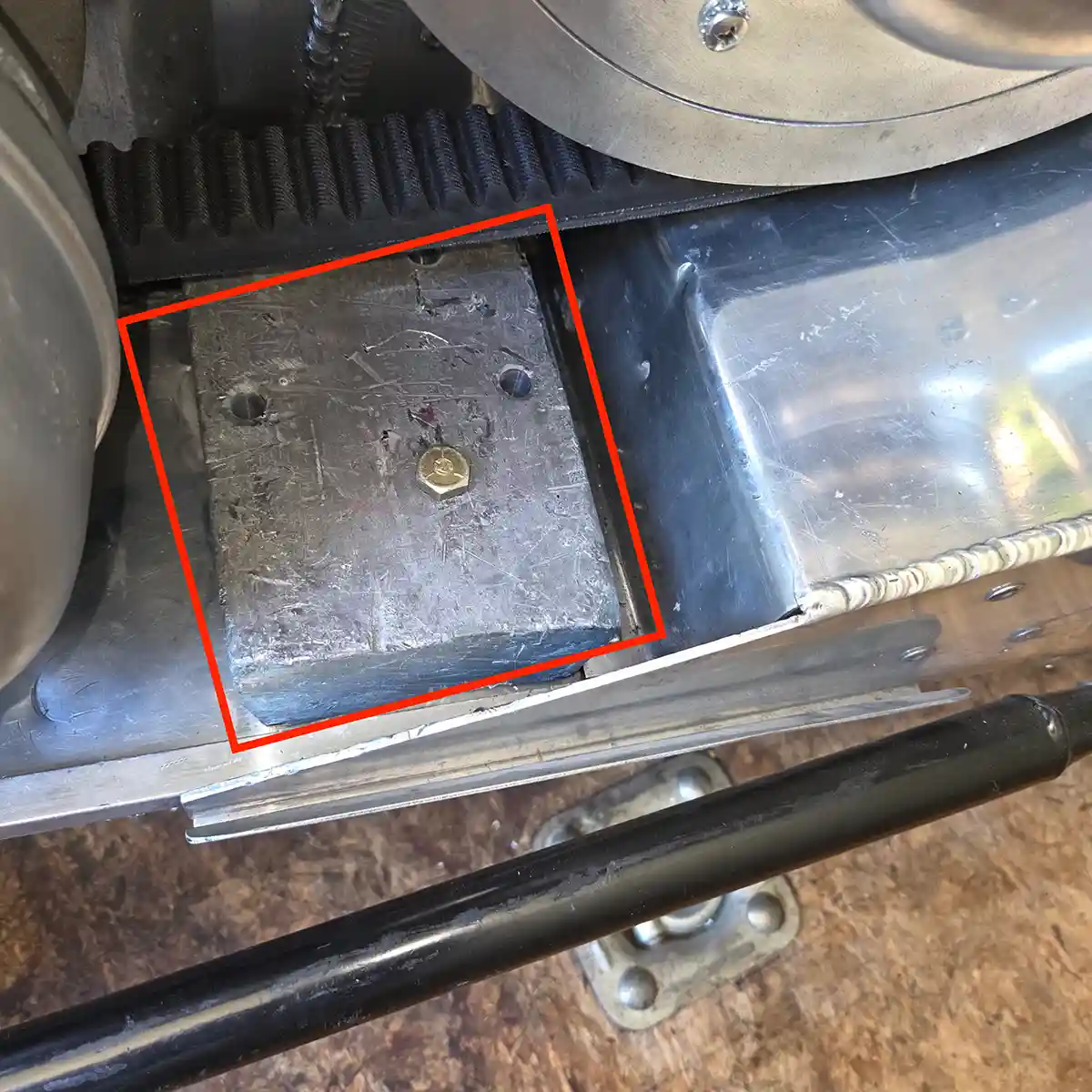 That changed thanks to longtime collector, racer and restorer Ken Simoneau.
While sorting through a collection of original Polaris parts, Ken discovered one of these elusive lead weights. During the restoration of his RXL, he bolted it back into its original location so it could be photographed.
As far as I know, the photographs in this article may be the first time many enthusiasts have ever seen one installed exactly where Polaris intended, including me.
Considering how many RXLs have survived and how few of these weights remain, it may be one of the rarest original production Polaris parts you would ever hope to find to restore a 1978 Super Stock back to its original factory-fresh glory.
